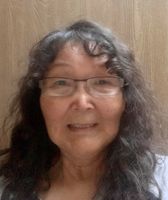
Sassa Peterson
Growing up in Manokotak, Alaska, Sassa saw her mother supplement their family’s commercial fishing income with skin sewn items and grass baskets. Her great grandmother Annie Mulngak first taught Sassa to sew sug’aqs (Eskimo dolls). As a pre-teen, Sassa was intrigued with beaded earrings and bracelets that the pastors’ wives and daughters wore from the Kuskokwim. Sassa made her first earrings and gave them as gifts to ladies who admired them. Sassa started to sell her earrings as they requested more to be made from her.
While attending college in Southeast Alaska, she took a beadwork and skin sewing class with a renowned Southeast Beader and Skinsewer, Esther Littlefield. Sassa made her first pair of sealskin moccasins for her husband. Later on, when she and her husband were teaching in Dillingham, their pastor’s wife taught Sassa to make beaded bracelets. She enjoyed making bracelets and entered her matching quill earrings and bracelets to juried arts and crafts show at the community’s Beaver Round Up. She was surprised to get first and/or second place in her beadwork and was inspired to sell her beadwork from then on, entering art and craft shows during Fur Rondy. She expanded to sewing Eskimo yo-yos, dolls, and kuspuks, sealskin vests, moccasins, baby mukluks.
When she got hired to teach as a Bilingual/Multicultural certified teacher in Dillingham, she was expected to teach native dancing so she and other interested individuals got some elders who still knew dances to teach them and formed Aruvak Dancers, named after the main teacher of the dances, Elder Elena Bartman. Sassa taught the children the dances she learned and also submitted Aruvak dancing on videotape and were selected to perform during AFN. She is pleased that those dances she taught & recorded are still taught to children as well as to interested individuals as far as Seward and Kodiak, Alaska! Even the former President Barack Obama danced them in Dillingham in 2015!
Sassa worked with elders over the years while taking summer classes or working with MCC (Math in a Cultural Context) where the elders shared their knowledge and expertise. Sassa learned how to use hand/arm measurements to measure for example in making kuspuks (qaspeqs). When her family relocated to Kenai/Soldotna, Sassa supplemented their income by selling her crafts at Saturday market as well as the Kenai Art Guild show and Christmas bazaars, continued selling at Fur Rondy and expanded to selling during AFN. She told newcomers from villages or hub villages such as Bethel area villagers that she supplemented their family’s income by making arts and crafts and encouraged them to do so. One of them was Michelle Konig and her mother, encouraging them to sell during bazaars and/or at PAG. Once Michelle made a whole lot of kuspuks that were too small and weren’t selling, so Sassa told her that maybe she could extend or add to the sides which Michelle did, adding a modern cowl pak design which became very popular and Michelle asked Sassa to sew for her. Sassa was reluctant at first but since Michelle persisted she was trained and joined in taking orders and now has a qaspeq facebook page, Sew Sassy Qaspeqs & Crafts that Michelle Konig made for her which includes modern designed kuspuks (qaspeqs).